Showing posts with label equity. Show all posts

Wednesday, August 18, 2021

Becoming, always becoming, a MORE Equitable Educator: Reflections on my learning

Image of a woman with a handbag on a purple background.
 Text reads: MIT Teaching Systems lab Becoming a more equitable educator.


ABOUT THE COURSE AND MY ROLE

In my role as a community teaching assistant for the MIT Teaching Systems Lab course Becoming a More Equitable Educator, I have learned a lot, interacted with a great variety of educators, and written more than I could have ever imagined.

However, my learning, both from being a student in this course and from participating as a teaching assistant, has been wide ranging and also very action oriented. This is the place for me to talk about what I've done with some of that learning.

USING COMMUNITY ASSETS


image of a two people chatting on a computer and table. 
Text reads: Using community assets. Who are the experts in my community? 
What assets do I have?
During the course, educators are asked to develop a map of community assets. I did not realize that this asset map would serve as a foundation for a great deal of the work that I would do for this past year. I found allies and tapped into an amazing community of educators who had a lot to share about their own work in becoming more equitable.

I felt empowered- because of a new job and a strong sense of wanting to do something- to bring some educators together and create some trainings and resources to address equity in my teaching community. 

Here are some of those trainings and discussions:


Staying true to yourself (with Elicia Cárdenas)

This is equity related, just not directly. It is about making principled choices in teaching, albeit in a very specific context of comprehension based communicative language teaching. The more I explore this topic, the more I am sure that this is about equity.

A conversation on equity and engagement: what does it look like in 2020
with Bob Patrick, Meredith White, John Bracey, Dahiana Castro, and Elicia Cárdenas

EXAMINING OUR STATUS QUO

image: stack of books. Text reads: examining our status quo. 
What are commonly accepted practices that no longer fit with my goals of becoming more equitable? 

There are a lot of commonly accepted practices in world language classes, especially around assessment, that I felt like I needed to really dig into and ask if they were practices that were in line with my goals of becoming more equitable. It turns out that I had a lot to say about engagement, grading accuracy, participation, and more. I *still* have more to say, so when I write more, I will add it.

Addresses equity in our choice of pedagogy 

Things to Avoid: Grading Accuracy, Participation, and Engagement/Effort

UNDERSTANDING THE ROLE OF SELF CARE IN EQUITY WORK

image of a woman with a large heart. Text reads: Understanding the role of self care. 
How does taking care of myself help me be more equitable?
 

This idea has been slowly coalescing and is still in its infancy. It started with a truly transformative experience at the People of Color Conference in a session about the trauma of equity work. I realized that I was carrying around a great deal of trauma from my experiences in working as part of an Equity, Diversity, and Inclusion team. Like- A LOT. While that workshop was specifically focused on healing from trauma, it made me start to wonder:

How can taking care of myself and putting myself first help me be a more equitable educator? Here's what I came up with:

I can be my best self, more often.

If I am well rested and not stressed, I am less likely to react, and more likely to either notice a situation that is going off the rails before it happens or respond in a way that is kind and patient. Hangry me just snaps, gets annoyed, and kicks kids out or shamed them (we have all done it, and I am not proud of it). 

When I show up with my best self, I am much more likely to have an equity mindset. I am more likely to look at any student in any given moment with an asset based and context centered mindset.  

I can focus on what is important, more often. 

If I am taking care of myself and not spending every extra minute doing things that I hate (e.g. grading for the sake of grading, marking errors, etc.), I might also be taking more time to plan better lessons, to create time in my lessons to check in with students, creating or finding better resources, or (gasp) even connecting with other teachers to support my practice. 

This has played out for me in some really significant ways: by being more intentional about how I spend my contract hours, by setting clear boundaries with myself and with others (and still keeping my job!), and being intentional about how I spend my time at school, I found that I had a lot more energy to plan better lessons and find amazing resources, with which to plan better lessons. Prioritizing a manageable work-week was a game changer. Also, it made me sleep better, spend more time doing the things I love, which led to less stress and me being my best self.

I have more energy and resiliency.

I have more energy and resiliency to have hard conversations, to take risks as an educator, and to practice being aware (instead of avoidant).  

I started to explore this idea in a handful of earlier blog posts (What Matters Most and Simplify) but the difference between what I wrote then and what I am thinking now is that self care is not just a nice thing to do, it is vital to be able to engage in the day-to-day work of becoming a more equitable educator. 

Image: people dancing with joy. Text reads: I can be my best self, more often. I
 can focus on what is important, more often. I have more energy and resiliency.


CONCLUSION

What a funny thing to write! There is no end. It's not like I have magically reached "equitable". It is a life-long process. I am constantly learning and un-learning. I am exploring the intersection of anti-blackness, fatphobia, and the role of white supremacy in eating disorders and the thin ideal. I am examining my own intersectional identities as a white skinned chicana, as my family digs out evidence of our very near indigenous roots, and looking at my role as a descendent of colonizers and of those who were colonized.  I am grappling with social media activism (and its harm) and growing my own capacity to be a leader. These are not easy things. 

So, no conclusion, sorry! 

(The course from MIT Teaching Systems Lab ends on August 26, 2021.)

Sunday, June 27, 2021

Title: Grammar Teacher. Goal: Language Acquisition.


Image description: beige background with hanging plants.
Text reads: Title: Grammar Teacher Goal: Language Acquisition


Teaching Spanish Again (online)

I got to teach Spanish last week! This past year, I have not really been teaching consecutive language lessons aside from short (5-20 minute) demonstration lessons. And you know what? I REALLY LIKE TEACHING SPANISH. I had so much fun.  

But the intention of this post is to talk about the part of the job that initially terrified me: I was hired with the title of "Grammar teacher." 

I was handed a workbook/textbook with a syllabus that included an extremely long list of discrete grammar points, explanations in English for each, cultural information in English (!!!), and activities such as "verb conjugation Battleship" wherein students utter verb conjugations to try to win. No communication involved.  (Also, #nojudgement if you played this game in your class. I did when I first started teaching, or some variation of it.)

I was invited to teach in an adult Spanish immersion program, taught this year virtually. So yeah, I was seriously walking the walk that I talked about all year long- re: teaching online.  Fun fact: I don't feel like a hypocrite!  I think my workshops for teachers teaching virtually were spot on, because I was using everything that I talked about. 

Plus, due to low enrollment, I was also supposed to teach a split two levels: "intermediate low" and "intermediate mid". I am using quotes because these levels are not in any way aligned with ACTFL proficiency descriptors.  So, two workbooks/syllabi/sets of grammar topics to teach. In 8 hours total. 

Program Disconnect

As an experienced acquisition based teacher who spends most of her time talking about how language acquisition works and what we can do in classrooms to make it happen (that is, Director of Training for The Comprehensible Classroom), I know that following the workbook will not help students reach any kind of language goals, and furthermore, will likely cause anxiety and/or frustration in many- even if it is what they are expecting. 

Read that again- even if the "paying customers" are expecting explicit grammar instruction, even if the school expects it, I know that teaching and practicing explicit grammar is not going to actually meet the goals of the program or the students. The fact that there is such a huge disconnect between the goals and the expectations and reality is a problem that I think many teachers can identify with.  Right? 

This teaching job was a new role for me- my first time teaching in this program. I was invited in thanks to some wonderful mentors Laurie Clarcq, Skip Crosby, Michele Whaley) but I was totally the new girl on the (virtual) block. 

So what do I do? How can I do the best for the students and their wonderful brilliant brains? How can I convince them that acquiring a language is joyful and not about hard work and studying, while still meeting the expectations of the program? How can I help them acquire language and hopefully get invited back? Again, these are questions that I think many teachers struggle with. I know I am not the first to be in this position!  

Image description: green background with houseplants.
Text reads: I know that teaching and practicing explicit grammar will not meet the program goals.

And also...I do have strong opinions, based on research, experience, and evidence, about what will help students acquire language. I feel confident that I can make a real difference in their Spanish acquisition if I am given the chance to do so. 

Now that you know the context of my teaching and the constraints, read on for the thought processes I went through to decide what and how to teach, and a little bit about what ended up happening and what a unit looked like (in part 2). 

Considering Expectations 

In order to even begin planning out instruction for the class, I had to stop and ask some important questions about the program: 

#1: What are the true expectations (spoken or unspoken) of the administrators and/or other teachers? 

#1a: What are the consequences of not meeting the expectations? 

Well, it turns out that although the textbook lays out a daily plan and scope and sequence, there is not a lot of clear expectation from the administration about how to follow it.   In this case, there is also not a lot of expectation from the teacher "above" me (next level) because there is a general understanding that we teach the students that we get, not the students that we want.  Since students self-select into these classes, there doesn't seem to be much blaming other teachers. 

(Which is a whole other issue- I mean- does blaming the level 1 teacher for students not being able to do something that is developmentally inappropriate really help anybody? That is probably another blog post,  and we will be doing a whole Fun Club episode about it later this summer. Stay tuned.) 

What are the consequences of not meeting the expectations? As far as I could tell, in this context, the worst consequence would be to not be invited back. After speaking with other acquisition focused colleagues who dispensed with the textbook as well, I decided that was unlikely. 

You know why? Because success builds motivation, and when students are happy and feel confident, like they learned something, they are very likely to tell administrators (or in school situations, their caregivers, who in turn tell administrators).  Administrators like happy students & caregivers. 

One thing that I have learned from teacher-leader Angela Watson is to really ask questions like this rather than assuming that we know the answers. Teachers are often mistaken about expectations and consequences- sometimes because no one really cares, or sometimes because administrators really do have our back and trust us to be professionals.  I encourage everyone to make instructional decisions based on actual facts about your teaching context. 

#2: What is really possible to achieve in the time frame?

Image description: off white background with houseplants.
Text reads: How much is realistic to do in the given time frame? 

Pretty much every scope and sequence from a textbook about what to do in a certain time frame is completely bananas. My two syllabi were no exception.  Plus, contact hours were cut due to being online, and I had a total of 8 hours with students. 

More importantly: we know that explicit instruction does not turn into implicit learning. There is a great deal of evidence for this. You can take a look at this very recently published paper: Was Krashen Right?  published by Dr. Karen Lichtman and Dr. Bill VanPatten for a fascinating discussion of this research and other extremely relevant ideas if you are into that sort of thing. 

Other sources for information about second language acquisition that are quick to read include my very favorite books for language teachers: The Nature of Language: A short guide to what's in our heads (VanPatten 2019), and While We're on the Topic (VanPatten 2017), both published by ACTFL.  

So if I spend time teaching these discrete grammar points, even if I could teach all of them in the few hours I have (which is totally impossible), it's not going to help students acquire.  

It will likely be boring (for them and me), frustrating because the "rules" don't really make a ton of sense (because they are simply descriptors of incredibly complex systems and don't adequately describe what is really going on in our language systems), and the end result will continue to be "wow, I just spent all that time studying Spanish but I can't communicate."  

"But I learned that way"

Some of you reading this might be thinking "Wait. I acquired my language with grammar explanations. I know the rules for ser & estar /imparfait & passé compose/ subjunctive / stem-changing verbs, so what are you talking about?"  

I ask you this: are you teaching you? Or the students in front of you? 

There is a very small percentage of students who can glean enough information from grammar instruction and practice to start acquiring a language. Language teachers tend to have been those students. In addition, I have observed that many teachers, when they reflect on their acquisition journey, discover that they really began to acquire when they studied abroad or were otherwise immersed in the target language.


Image description: green background with houseplants.
Text reads: Are you teaching the student you were? Or are you teaching the humans in front of you? 

Equity

To me, this is an equity issue. Some kids might be the ones who get motivated by grammar exercises, who can memorize and have strong study skills (and all the privilege that goes along with those things) and can pass tests and get into upper level programs (where there often is more reading & communication, which lead to acquisition) and eventually study abroad.  

But what about all the others? How many kids make it from level 1 to AP? And are they representative of the school's population? Why don't all the kids go on and feel like they can acquire another language? I mean, they already acquired communicative competency in at least one, effortlessly.  Why are those upper level classes reserved for a certain kind of student? 

And...I think it's important to ask ourselves: Are we teaching just some of the students or are we teaching *all* of them?  There is some fascinating evidence for rethinking how language classes are taught from an equity perspective. Take a look at Grant Boulanger's work with AP classes.   My work as a Teaching Assistant with MITx's (free) Becoming a More Equitable Educator class has shown me that teaching the students in front of us (and many other common practices in an acquisition based classroom) are in line with principles of equity focused teaching. I hope to write more about that soon! 

So what did I actually do?

I looked at the two syllabi: (click on the images to see bigger versions)  

Image description: Grammar syllabus.
 Click on the image for pdf

Image description: Grammar syllabus for level 4.
 Click on the image for pdf


I started a list of the big ideas in the grammar sequence: reflexive verbs, stem changing verbs, preterite/imperfect, ser/estar (to be in Spanish), irregular present tense verbs, present progressive.   I glanced at the themes (weather, professions) but decided that those were less important than the verbs. Although it is common knowledge that vocabulary lists are an important part of language study, I know that the most frequently used words are much more important, so, as the expert (the teacher) I am going to choose to focus my energy on the most important things from the list. 

How did I decide these things were more/less important?  And why did I even start looking at the syllabus with this in mind? 

Well, I was thinking about power standards and the idea of Marie Kondo-ing the curriculum. What is truly the most important to teach, and what can I let go of? This article from Carrie Toth: The Chuck-it Bucket  (Somewhere to Share) is a great resource, as was this article about using a textbook and still providing input that students understand: Comprehensible Input from your Textbook from Martina Bex (The Comprehensible Classroom).    I was also thinking about the most frequently used verbs and the words that I use in conversations and see in books vs. the words in the  textbook. 

Choosing a Resource

I thought about the SOMOS* units that I love that were appropriate for intermediate low students- and then thought about how the students were probably a mix of novice mid, novice high, intermediate low, and intermediate mid, based on the "placement test" which did not in any way assess communication or acquisition.   

Hmmm...SOMOS 1 Unit 21 has reflexives, irregulars, and stem changing verbs. Oh- and present progressive, irregular verbs, ser and estar (because they are used all the time!) and has a theme that is pretty fun to talk about for adults, especially adults in an outdoorsy place (Bend, OR).  And I have some authentic resources that I can use to do some higher order thinking activities (e.g.compare and contrast) and some other resources that are just fun. Also, I have taught the unit a few times and found it to be a really fun one. That's important for me! As far as adding in preterite/imperfect, well, that's easy- we can do some activities in the past tense- discussing yesterday, reading a story in past tense, doing a picture talk and asking "What happened immediately before x happened?" and that sort of thing. 

Now, if you don't know the SOMOS curriculum like I do, this might be more of a challenge. You could ask colleagues for recommendations, ask on a collaborative facebook group, or check out a curriculum map. (You could do this with any curriculum!). 

You could also backwards plan from a favorite resource or theme by thinking of the most important words that make sense in that theme that *also* include reflexives, irregulars, etc.  

The thing is, you can can use almost any resource with almost any kind of language. If you focus on high frequency words, you get irregulars and stem changing verbs. If you are a little creative, I bet you can add direct object pronouns, indirect object pronouns, and of course, our old friend the subjunctive tense. Or anything at all. 

To recap:

I decided to use the textbook syllabi as guidance, but use SOMOS 1 Unit 21 as a framework, because there was no way I was going to be able to teach everything that was listed anyway, but I could use a lot of the kinds of grammar points included in the syllabi quite easily. 

Here is the syllabus with the grammar points that were going to be included in my lesson plan. The highlights are instances of words that we used again and again, in context. The notes to the side indicate either the activities that included that language feature or function or specifics about what I was going to focus on.  

Image description:syllabus with highlights and notes; click on image for pdf

Image description: syllabus with highlights and notes; click on image for pdf

Notice that not everything is included. In 8 hours, it would be completely impossible to do everything, and some things are more important. This is where experience and judgement come in: deciding what to keep and what to get rid of. 

Did I get it perfectly right? I have no idea! But again, the important thing is that students hear and read a ton of target language that they understand, and that is the plan. 

Setting student expectations

Once I had my plan, I also had to consider how to set expectations for the students in my class who were literally sent the textbook/workbook ahead of time with an email saying "Elicia will be using it". 

A colleague recommended that I create a workbook with an answer key, and offer students the opportunity to do the exercises on their own time, which I did. For both levels. 

I also decided to be very up front with students and explain that time together with me was going to be spent using the language, rather than talking about the language. I took about 5 minutes to talk about how language is acquired when we understand messages and when we communicate, and that is something that we can only do together, and that the workbook was there for them to use on their own. 

Image description: light brown background with houseplants.
Text reads: We spend time in class using the language instead of talking about the language. 


Each day, I shared another quote about language acquisition (e.g. "Students studying language have the best chance of success through reading-Dr. Stephen Krashen") at the beginning of class. It took about a minute.  When one student (who was not there for initial introduction) asked if I could provide them with lists and rules, I paraphrased the introduction and shared the workbook again. I directly addressed the difference between using the language (listening, understanding, reading, writing, speaking) and learning about the language, and reiterated that we were going to use the language since that was what we were there to do. (And yes, I did all this in English because I wanted to make sure they understood!


Read part 2  for a detailed discussion of my "Unit Plan" and some reflections.

Saturday, March 20, 2021

Things to avoid Part 1: Grading accuracy, participation, and engagement/effort

Things to avoid: grading for accuracy, participation, effort. Text is overlaid on a terracotta and lavender background.


There was a discussion on a Facebook group page that asked for guidance regarding grades and grade books.  I was surprised to see the number of teachers who count things like accuracy, participation, and effort.   

Now, my thinking has changed a bit, especially on participation and effort, as I continue to decolonize my classroom, my teaching practice, and my curriculum in my journey to become a more equitable educator. 

 (Update on that: I am also a Teaching Assistant now for the MITx class, Becoming a More Equitable Educator, that was so impactful for me last year, and it is just as impactful going through it again and working with learners from ALL OVER THE GLOBE in their pursuit to become more equitable educators.  It is *free* and great.)  

I am really struggling with where classroom management, white supremacy and systems of oppression, and my classroom practice intersect, but I have no clarity, so I am going to keep struggling on that and asking questions and seeing what I can think of.

However, over the course of my work and collaborations with amazing educators, I have really come to understand more about the role that grading for effort, accuracy, and participation/engagement play in a comprehension based classroom. I don't think I have all the answers, but I have some strong thoughts! 

 In terms of grading for participation, effort, and accuracy, I would say that all of those concepts may allow teacher bias to strongly interfere with grades.  They create systems of  rewarding some students for being better at "playing school", and reinforce a "numbers=learning" mindset.  And of course, if some students get rewarded, other students are going to be penalized.  

As I continue to work with teachers on assessment and grading practices, this student (and caregiver) mindset about numbers (percentages, points) being the equivalent of learning is consistently the number one issue that teachers have, so it is worth considering how our classroom practices play into creating the situation in the first place.  Remember that effort and participation might look a lot like compliance, and grading for compliance is never a good idea. Read my previous posts about grading for accountability, which is another way to say compliance.

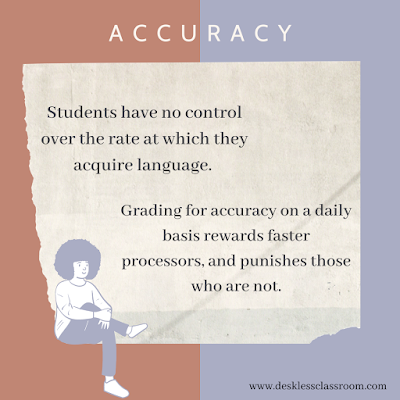
Text reads: Students have no control over the rate at which they acquire language. Grading for accuracy on a daily basis rewards faster processors and punishes those who are not. Image of a girl with an afro sitting and smiling on a terracotta and lavender background.

Grading for Accuracy 

Since students have no control over the rate at which they acquire, grading for accuracy on a daily basis is going to reward only faster processors and punish other students for not being faster processors.   

Research about Ordered Development tells us that language features (verbs, word order, what we think of as grammar, etc.) is acquired in an order that is independent of instruction. 

That is to say, it doesn't matter how many times or how creatively a Spanish teacher teaches the difference between ser and estar (to be and the other to be) or the difference between the preterite and imperfect past tenses, students will not produce them until their brain is ready, and when they have traversed the developmental stages of acquisition for that word (or language feature).  Furthermore, learners move through those stages in a non-linear fashion!   They may be able to use a feature accurately one day, then in another context revert back to an earlier phase of development.  This developmental order plays out in every language, for every language feature, no matter what the learner's first language is. We see it in first language development as well.  For more information about ordered development, there is a paywalled article in Hispania by Dr. Bill VanPatten, as well as his great books available from ACTFL: The Nature of Language and While We're On The Topic".   

Accuracy is probably the least important component of proficiency.  Consider: for those of you that have very young children, can they communicate with you?  Of course! It is usually imperfect and often adorable, but it is communication. For those of us who prefer four-legged furry friends, do you know when your dog or cat wants something? I sure do, and I speak terrible Dog and her English is just as poor. But we communicate! (Usually.)   

Why would we expect our students to communicate about something accurately after mere tens of hours of instruction? Even after hundreds of hours (600+) of instruction, the rather small percentage of students who reach a proficiency level of Intermediate Mid (ACTFL proficiency scale) can only do so much.  For example, they can handle concrete, familiar, and predictable situations but might have difficulty linking ideas and time frames, and they are not expected to be accurate speakers of the language.  Read about that study here, and my analysis of it when published:  What Standards Should I set for my students? 

In short, we should not grade students for accuracy, especially on a daily or weekly basis.  


Grading for Effort

Effort is another tricky concept. Many teachers say that if students are trying, then they are making the effort. But what does that look like? Does "trying" look the same across cultural contexts? Does my "trying" look the same as someone else's? And if the teacher sees someone trying, but doesn't see someone else, who gets the reward (the grade)?  

This goes right along with the familiar teacher practice of "well, little Johnny tried really hard so I will just bump up their grade because they deserve it."  Now, that is coming from a place of love and support, but wow- there are so many issues with that!  

First, if we bump up one kid's grade, why don't we bump up another? Who are we to judge how hard one kid tried and value that over another? Do we have the right to make those calls? 

Again, I guarantee that our implicit biases are going to come into play.  If we bump up the grade, do little Johnny and their caregivers have an inflated idea about what they can do in the language? Or does it mean that little Johnny gets credit despite not being able to meet a performance target?  

Grading for effort is a dangerous road, fraught with opportunities to let implicit biases reward students who understand the dominant cultural norms of the classroom and/or fit the teacher's definition of trying hard.  


Text reads: PARTICIPATION: Learners don't have to speak in order to acquire language. There is an image of a black man with a beard holding coffee, in terracotta, yellow, and beige.

Participation

Participation is also one of those concepts that needs to be carefully considered. The silent period (lasting 6 months to two years) is a documented stage of language acquisition. We also know that students do not need to be speaking in order to acquire language (they do need to be participating in communicative events, but that doesn't mean speaking!) 


Students who are not neuro-typical may demonstrate participation differently, as might students from other cultures. Again, teacher bias may strongly affect these grades, rewarding kids who are good at "playing school" and/or who understand the norms of the dominant culture.

But What About Engagement?

But wait! Don't you ask students to engage in class?  Don't you expect them to take risks and try to use the language?  


The answers to those concerns are COMPLICATED.

Engagement and participation are DIFFERENT in my book. Participation often looks like forcing kids to speak before the words come pouring out of them, or to speak in complete sentences. It also might be coupled with the belief that students must take risks in order to acquire language.  

I do not believe that students should feel like they are taking risks in speaking in my class.  My goal (and it *is* a high bar, I recognize) is that they feel like they have so much to say and they want to say it so badly that words just pour out.  

Engagement is something that I am really working through.  In order to meet the need for enough grades in a grade book, in my last school placement I asked students to self-assess on behaviors that support language acquisition, then I recorded that grade. (You can read more about what I used to do in this blog post: What goes in the Grade Book.)  After a while, I continued to ask students to self-assess, but recorded it less and less.  The practice was useful in some ways, but now I am really asking myself some hard questions about how I was rewarding those kids who played school (and penalizing others, including students from different cultural backgrounds and those who would be considered to be neurally diverse), and how I can try to reach the same goals (helping students self-regulate and attend to the input) while eliminating white supremacist culture in my classroom.  This is an ongoing exploration for me.  Whew!  


Text reads: the ways we grade can help us become more equitable educators. The ways we grade should help all students believe that they are capable of acquiring another language. Text is beige on a terracotta and lavender background.

I truly believe that the way we grade can help us become more equitable educators, and that the way we grade should help all students believe that they are capable of successfully acquiring another language. 


Friday, January 29, 2021

Part 2: Reframing Accountability in a comprehension based classroom

If you haven't read Accountability, Part 1,
please do so!  

Image description: geometric figures in dark blue, brown, and light green with the words Let's talk about accountability.

What does it mean to reframe accountability for a comprehension based classroom?

Thanks for asking!  I think there are some very concrete steps that we can take to support learning for the sake of learning and move away from the point based transactions in our classrooms. 

Please remember that changing the culture of a classroom, department, school, and community is not going to happen at once. Sometimes, all you can do is start behind your closed door, and that's ok.  Sometimes you might have to be
quietly subversive- which is OK too because being subversive might mean doing what is best for your students behind closed doors.  

Image description: geometric figures in dark blue, brown, and light green with the words 1. Grade and report on mastery. 2. Set achievable standards. 3. Change the focus from points to proficiency. 4. Build relationships and community. 5. Teach content that is relevant.


But what do I do???

1) Grade and report on mastery of standards.  

This is also known as standards based grading. You can do this even if your school reports grades on an  A-F scale.  A key idea in standards based grading is that teachers report accurate information about mastery of standards, and exclude information about engagement, timeliness, behavior, and practice in the mastery grade.   

2) Set standards that your students can reach, and celebrate what they can do!

Here is a brief article with suggestions for reasonable standards in a comprehension based classroom: Performance Targets.  

3) Change the focus from points to proficiency.

Teach what different levels of proficiency look like to your students and share that information with administrators and parents,  and be transparent in how you grade and assess.  Put rubrics directly on assessments and use consistent language for all assessments.  This helps change the conversation from "how many points is this worth?" to "look what you can do"!  Here are some ideas and a lesson plan to address how I did this with students.   I am proud to mention that the head of the school used the display  that we created from this lesson as a regular stop on tours for prospective families and school visitors.  It helped frame expectations for all stakeholders and create a common language. 

4) Build relationships and community. Connect with students.

Use all the wonderful comprehension based strategies that you learn in workshops (or wherever you get training!)  to build relationships, connect with your students, learn about their interests, and build a community where students feel seen, safe, and joyful.  

These strategies might include: Special Person Interviews, One Word Images, Chit Chat, Card Talk, Weekend Chat, Personalized Questions and Answers, and my all-time favorite: Story Asking.  There are SO many more things that can be done in comprehension based classes-don't be limited by my imagination!  

 Remember that learning how to do this kind of collaborative teaching takes some skill, practice, and might feel different for you as the teacher and very different for students. That's ok!  Give yourself some grace. 

Also remember that these strategies, when grounded in a framework of communicatively embedded input, are based on a principled understanding of the mechanics of language acquisition.  While it may look like just talk and play, these principles truly meet the definition of "student centered."

CARLA (The Center on Advanced Research for Language Acquisition (CARLA) defines student centered instruction as “Instruction that builds upon what students need, already know, and can do.” Note that the definition does not dictate roles or activities in a lesson, but instead tells us that the content of the lesson is what makes something student centered.  In our framework, what students need is consistent and comprehensible target language input, what they already know is about their own lives and interests, and what they can do is communicate (which includes interpretation) about those interests. Thanks to Martina Bex for making this important and relevant connection and her explanation in her article Proficiency Oriented Language Instruction.


Here are a couple of video resources about connecting with students: (Although I have been ignoring this little blog quite a lot lately, I have been incredibly busy doing other things!)

5) Find and teach content that is relevant and moderately interesting.

Use the information that you learn to find and create comprehensible content that is moderately relevant and interesting to your students. You don't have to have a home run story or unit each day or week or month- but trying to keep class personalized and connected to their lives is important.  

Even if I know that I want to teach about something that is content-related, I am going to try to use student experience and background knowledge to build interest and connect them to the content. Pro Tip: The SOMOS / Nous sommes / Sumus curriculum uses this framework for all units and it works incredibly well.  

A concrete example from my own classroom might be a learning sequence that looks something like this: 

Novice Spanish 

Note: I have done variations of these activities in Spanish 1a, 1b, and  1 honors. 

Content: Brandon Brown Quiere un Perro, by Carol Gaab (Fluency Matters)

Connection/relevance: Pets that students have or want to have/have had.  Responsibilities and fun/not fun parts of pet ownership.  

Ideas

Students submit 1-2 pictures of their pets (or pets they want/have had, stuffed & mythical animals included)  and a short L1 paragraph about their pets. I put together a slideshow of their pets with L2 sentences that I am confident that we can read together.  I show 1-2 slides each day as a warm up and lead a comprehensible L2 discussion about the information.

Discussion: Which pet would you rather have? I present 2-4 different types of animals as pets and we discuss the pros/cons of each, in a scaffolded L2 discussion.   

Story: We co-create a story or two (TPRS©) to pre-teach vocabulary from the book that is unfamiliar. Using actors, pictures, and student ideas, we build the story then play with it.  The story becomes part of our community narrative- relevant, personal, and usually hilarious.   

Having created some community experiences around pets, shared opinions and laughter and probably disagreed about pets, moving into the book (the content) suddenly feels more relevant. When Brandon's dog chews his favorite pants in the narrative, we can relate that to the time Luis' snake ate his sister's hamster, and then perhaps have a whole discussion about gross things that pets eat and shouldn't. (True story. One of my best classes ever!)  

Image description: geometric figures in dark blue, brown, and light green with the words My Vision: All students feel like they can succeed. Classrooms are places of joy, language acquisition, and equity.


But wait! Don't you have to give grades? Sure, of course!  The difference is that I don't want to trade points for behavior.  I want students to be interested in what we are doing in class because they are motivated by relationships and relevant content. (For more great information about motivation, please check out Liam Printer's The Motivated Teacher resources and podcast.)    

You can read about what goes in my grade book if you like.  Notice that I had to fit my beliefs about standards based grades and what should go in the grade book into the culture of my school (and make compromises).  

I recognize that all 5 of these steps are big. None of them can be accomplished over night, but I do think that in reframing accountability and points-as-motivation,

I am positive that we can make sure that all students feel like they can succeed and center our classrooms as places of joy, language acquisition, and equity. 


Part 1: The A word (Accountability)

Image description: geometric figures in dark blue, brown, and light green with the words Let's talk about accountability.

Let's talk about the A word. I'm talking about accountability, friends.  I have been chewing on some ideas about this word for a long time, and have recently been able to put to words some concerns I have about this idea.  

Holding students accountable for their learning is not inherently bad.  Conflating compliance with evidence of learning (or in our case, acquisition) is not the same as holding students accountable for their learning.  And in fact, the whole idea of accountability might have some problems, at least the way it is used when applied to students.  

Accountability often comes up in discussions about student engagement.  It usually sounds like this: "How do I hold them accountable for ___?" and when teachers are more frustrated (sometimes feeling defensive, especially when we are talking about the intersection of grading, assessment practices, and equity), "but they won't do it if I don't hold them accountable/give them a grade for it."  

First, I hear you, and I feel you, and I am not in your context, and I am not here to judge.  We are all just trying to get through this crazy year, and all the crazy years.  

Second, I want to unpack a few ideas wrapped up in what teachers mean by student accountability.  

Finally, I hope to offer some fairly concrete ideas for how to reframe accountability in a comprehension based classroom.  (See Part 2.

Since this is my blog, this is real talk. This is me, unfiltered, and asking hard questions.  It's ok if you don't agree with me, but I do think it is worth asking hard questions about our classroom practice. Don't give up on me. 

What "holding students accountable" looks like (based on observations and discussions with teachers) 

  • Assigning point values to every thing done in class and collecting and grading it all, e.g. collecting and grading bell work/starters.
  • Requiring that students complete "proof of learning" such as graphic organizers (that don't prove anything, really) or filling in guided notes. 
  • Giving students assignments to complete that have little-to-no relevance for learning or acquisition, e.g. assigning busy work to be completed after free voluntary reading to prove that students did something.
  • Believing that students won't do work unless there is a grade attached.
  • Rewarding compliance (doing the work) and conflating compliance (or lack thereof) with learning.

(Please know, I have done most of these things and held these beliefs, and I am not in your context nor do I have to comply with your school's expectations. These are just examples.  #nojudgement)

Who gets held accountable in our general adult world?

Well, I am accountable for being licensed to drive and having insurance- or at least, if I was caught without those things, I would have some kind of consequence.  Often, our society talks about holding people accountable for misdeeds and violence against others.  In fact, accountability seems to be very closely related to punishment or consequences for doing harm. 

I am sure that there are a million other ways to consider accountability, so please forgive me if this is just one facet of this complicated concept.  But- as we are seeing such a disproportionate rate of students of color receiving behavior referrals1, it does seem pertinent, right? Holding a kid accountable for their behavior/compliance  often results in punishment. This punishment might be low grades, which research shows is not a motivating factor2.

Why do you do your job? What makes you accountable?

Then there is the idea of holding people accountable for doing their job.  I am expected to show up to events and workshops and classes that I have scheduled and contracted, and provide the services that I have agreed to provide.  I am held accountable by the very real consequences of losing my job.  But that's not why I show up. I show up because I chose this work, I like this work, and I am motivated to engage in this work.  

Few teachers are motivated by money (although there is *no* doubt that we should be paid fair and equitable wages, and not be shamed into working 60+ hours a week or risking our lives "for the children").  And if you are just motivated by having a job- that's ok- we all need a job! 

 So what motivates you to be accountable for your work? Is it fear? Is it the paycheck/health benefits (no judgement!)? Is it the sense that you are doing something bigger for your community? Is it that you adore the students and love what you do? Is it your love of your school community and colleagues?  Are you motivated to show up for work or are you held accountable? Are those factors in balance?  

Let's talk about the kids in the classroom

Considering a few different reasons to be held accountable and some motivations for doing what we are asked to do- as adults-is it reasonable to expect kids-to be motivated by external factors?   I mean- we are talking about kids, not fully formed adults.  And to be clear- I am speaking now very specifically about kids in a classroom context, and how they are held accountable or not for doing their job of learning in the classroom.  

Image description: geometric figures in dark blue, brown, and light green with the words External Motivation (low grades) is not effective motivation.

 
 This leads me to consider motivations- my own and those of students.   Giving grades to increase motivation really comes from a behaviorist framework of punishment and rewards.  This framework, also known as extrinsic motivation, has some problems.  Joe Feldman shares this critique:

[...] extrinsic motivation is not an effective motivation strategy for authentic learning. While extrinsic motivation yields benefits for menial and repetitive tasks- such as offering prizes for stuffing the most envelopes [...]extrinsic rewards and consequences have been found to be wholly ineffective to engage people in tasks that require higher-order and creative thinking [...]. (Feldman, Grading for Equity, 2019)3 

Grades as Rewards

This idea of grades as rewards- also known as a points economy- is so deeply embedded in our school culture that it is incredibly hard to reframe.  But consider: do we want students to be engaged in learning for the sake of learning? (Also, do we want them to be engaged in order to contribute to their community, to develop connections with each other and their community, and all those things we talk about when we create vision statements for learning?) Or, do we want students to be engaging in points transactions in classrooms?  Are we, as teachers, the brokers of points or guides for learning/language acquisition?  Rick Wormeli, a teacher and leader in supporting teachers in implementing equitable assessment practices, wrote this amazing response to a concern about moving to standards based grades. Take a moment and read it.  

OK, welcome back to talking about accountability.

When we talk about giving points for assignments (because otherwise students won't do the work) and rewarding the "good" behavior, we are doing harm.  Grades should not be rewards for compliance.

Image description: geometric figures in dark blue, brown, and light green and an image of a standardized test, with the words Grades are not rewards for compliance. They are indicators of progress.

We are engaging in points transactions rather than engaging learners. And, if students aren't engaged in the work, if they are not "paying attention" or "just turning in blank papers", isn't that a big neon sign pointing to the lack of connection and relevance of the learning to their lives?  Or...perhaps something else that is really important to know about the learner?  

This is a BROAD statement- but dig in with me here.  I know that teachers are social workers, food providers, emotional support providers, nurses, therapists, tech support, and all the other things that have been put on our plate.  And I know that it might feel like I am telling you that you have to do more. And it might feel overwhelming-especially this year, especially with remote and hybrid and roomies and zoomies and the global trauma that we are living through.  Give yourself some grace, but please, keep reading.  

When a teacher says to me "but I have to hold them accountable" by assigning a grade to each piece of learning, I want to ask the following questions:

1) Do you know why the student is not engaged? Have you asked them or their care givers? Have you listened to the answer? Have you used that information to support that learner within your means? (And if the answer is yes, or I have done all I can, that's ok! Read this great article: When is it ok to say you've done "enough" for a student? from Angela Watson.) 

2) Is what you are asking the students to do something that they can and wish to engage in?  Is your content relevant to their lives or at least moderately interesting? Do they feel respected as learners? Do they feel like they are capable of doing the task, and that it has a point?  Do they feel like they are part of a community? Do they believe that you care for them and see them as for who they are?  

3) How deeply are you and the students engrained in the points transaction universe?  

4) Do students think that they have a reasonable path to success in your class, despite not having the requisite points or making the choice to not do work? Can they recover? 

The Hard Work

I know. I KNOW.  I am telling you the hard stuff. I am asking you to think and dig in and reflect and perhaps admit something uncomfortable, and yes, work more, and harder.  

But this work- developing engaging curriculum, connecting withs students and building relationships, and giving students the opportunity to succeed- this is good work. It is important work.  If you can focus on this, and try to minimize (or even eliminate) the work that doesn't serve students, then you will have more time for building connections and creating curriculum that is truly engaging and relevant.  Here are some thoughts about focusing on what matters.

OK, you've made it this far. Thank you. In my next post, I will talk about reframing accountability and what this looks like in a comprehension based (acquisition driven, proficiency oriented, CI) classroom. This is getting REALLY long!  

References

1Riddle, T., & Sinclair, S. (2019). Racial disparities in school-based disciplinary actions are associated with county-level rates of racial bias. Proceedings of the National Academy of Science of the United States of America, 116(17), 8255-8260.)

2Selby & Murphy, 1992 as referenced by Tom Guskey, "Five Obstacles to Grading Reform," Educational Leadership, ASCD, November 2011

3Feldman, J. (2019). Grading for equity: What it is, why it matters, and how it can transform schools and classrooms. Thousand Oaks, CA: Corwin, a Sage Publishing Company.